

Too many alerts become noise
An uptime check tells you whether a service responds. It can’t tell a planned container shutdown from an unexpected stop, warn you only when low disk space persists, or group repeated SSH failures into one incident. Too many alerts become noise; too few hide real problems.
An agent that reads, rules that decide
- Host agent A small Go process that runs under systemd as an unprivileged user. It reads Docker, disk space on the host, failed SSH logins from the journal and pending Ubuntu updates from the local APT cache. It only reads: it never restarts a container or installs an update. If the server container is down, it keeps events in a local queue.
- Rule engine Thresholds, durations, cooldowns, quiet hours, maintenance windows and recovery messages. An incident opens once, is notified once and closes when the check recovers. State and history live in SQLite, and a durable outbox means no message is lost across restarts.
- Web dashboard A React dashboard to choose which containers to watch, review incidents and edit rules. It listens on the server’s loopback only, reached through an SSH tunnel or Tailscale. The server container runs as non-root, on a read-only filesystem and without the Docker socket.
- Telegram and iPhone Alerts arrive on Telegram. A native SwiftUI iPhone app pairs with the server through a one-time QR code that the admin approves, then shows incidents, services and rules. A demo mode lets you try it without a server.
Stack Backend: Go and SQLite. Host: Ubuntu Linux, systemd, Docker Engine API and journald. Dashboard: React, TypeScript and Vite. Deployment: Docker Compose. iOS: SwiftUI.

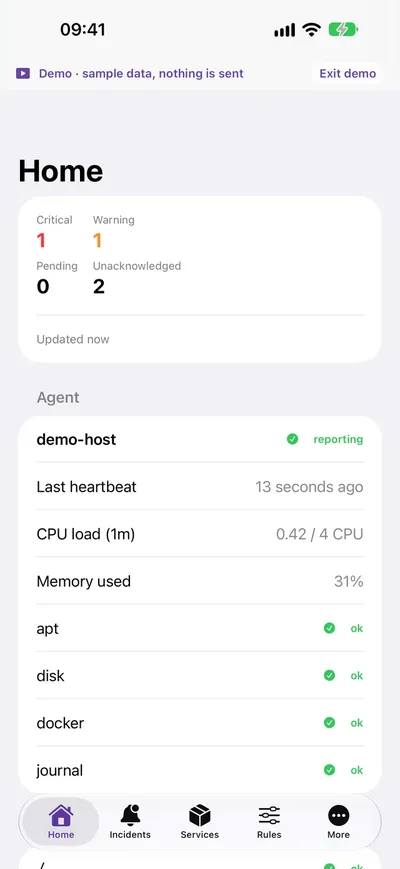
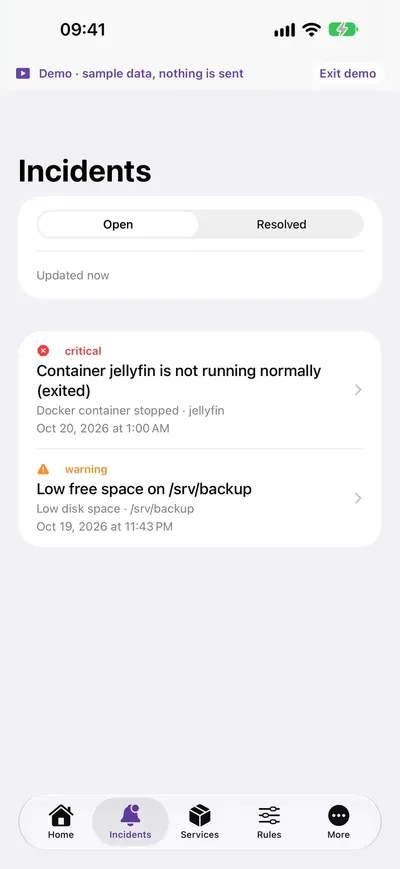
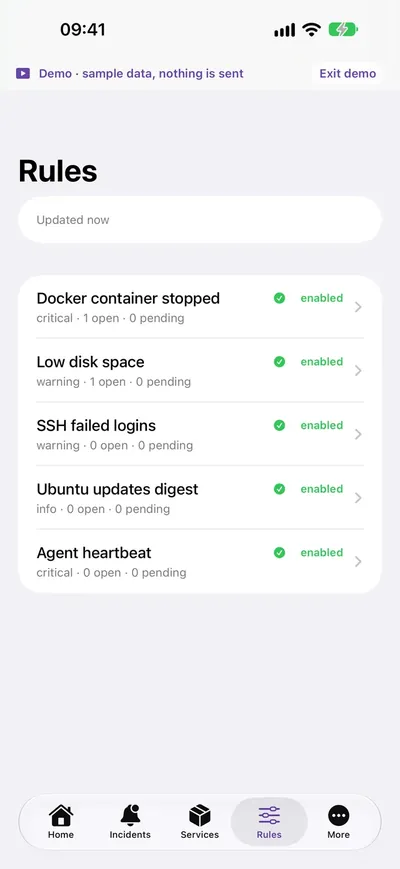
Running on our server, with a real iPhone
First code on October 19, 2026; the same day it was running on Ubuntu and paired with an iPhone. 18 commits by October 20, with CI on GitHub Actions running the Go race tests, the dashboard tests and a vulnerability check. Homelab Notify is now in alpha and runs on our own Ubuntu 26.04 home server: a test container stopped on purpose produced one Telegram alert and one recovery message, and the iPhone app paired with the server over Tailscale on a real iPhone. On that server the agent uses 7.6 MiB of memory. In local tests a stopped container became an incident in about 32 seconds, against a 30-second rule (median of 10 runs). The project site is online at binary-builderss.github.io/HomeLab-Notify.